

TIMERIDEHistorical Blog
Rose Monday 100 years ago
Celebrating in early times – is that allowed? In Colognecarnival this is not an unknown questionand is asked again and again. Even 100 years ago.
from Jonas Mortsiefer on 09.02.2026
War and carnival
In 1926, Cologne is caught between two stools: On the one hand, the British occupation is coming to an end and Shrove Monday is approaching. The economic situation is tense. But at the same time, the city looks back on over a decade without a carnival. After such a long time, people are hungry for experiences!
By 1914, the Cologne Carnival was already a highly organized major event: clubs, meetings, music, parade logistics – and an audience far beyond the city. The Rose Monday parade is the most visible expression and highlight of this organized celebration: “The city belongs to the fools” – within the framework of clear rules, with a stage effect and valve function.
The First World War shifted the coordinate system. Exuberant celebrations seem out of place in these serious times – the Rose Monday parade is canceled from 1915. After the armistice of 1918, pre-war normality does not return: the Rhineland remains under Allied occupation to protect France. For the people of Cologne, the British presence is difficult – the occupiers are sociable and correct, but always remind them of the foreign rule. Public celebrations remain restricted, street carnival is banned – in total from 1915 to 1926 without a regular Rose Monday parade. In 1924/25, Archbishop Schulte publicly tried to put the brakes on a revival of the carnival in the city – as a warning against “disinhibition” in unstable times.
The last British soldiers leave Cologne on January 31, 1926. A reason to celebrate for the people of Cologne! The whole city gathers in front of the cathedral to listen spellbound to Lord Mayor Konrad Adenauer proclaiming nothing less than a return to self-determination and freedom. And quite a few people must have wondered whether this would also apply to the carnival season that was just around the corner.
After all, public carnival events have been possible again since 1925 – as long as they take place indoors. A glimmer of hope for many people after years of a general ban on carnivals. However, the administration and police still consider the street carnival to be risky and inappropriate – also in view of the poor economic situation.
People in the city are torn – should we celebrate again?
Rose Monday 1926: "forbidden carnival"
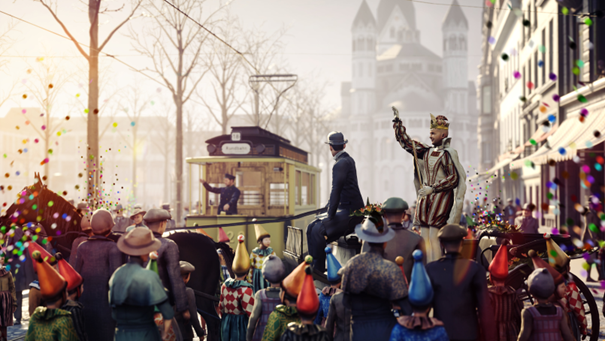
On Rose Monday 1926, the triumvirate nevertheless set a visible example. Prince Adalbert I (Dr. Adalbert Oster) takes the opportunity to drive through the city in an open, four-horse carriage – all the way to Deutz to the then still young exhibition grounds. There he wants to go to a carnival session. The people can no longer be stopped. You flock aon the streetoften in everyday clothes or improvised costumes, and cheer for the prince. the prince. Der police have no choice but to turn a blind eye.
The painting “Forbidden Carnival” by Heinz Kroh (painted in 1923/26, now in the Cologne City Museum) provides a powerful image of this transitional period: It shows a large, noisy group on the street – most of them without costumes, but with individual clowns; a woman marches in front, banging cymbals, and a British officer can even be recognized in the crowd. The picture makes tangible what carnival looks like in these years.
Bleak future
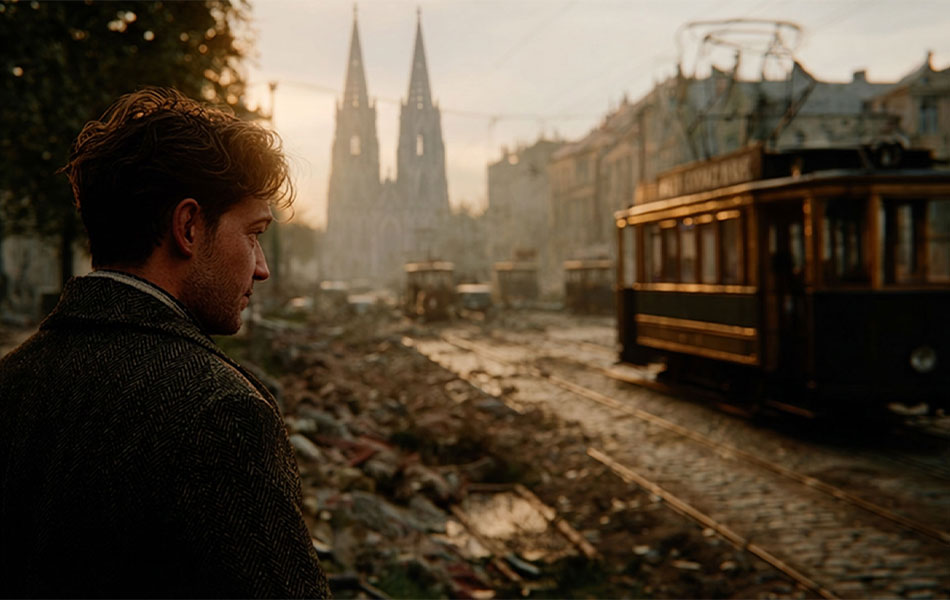
In the following years, it was finally time for “d’r Zoch kütt” again – the Rose Monday parade took place, as did the street carnival. However, the hopes for better and carefree times were not to be fulfilled in the long term. The National Socialists also gained a foothold in the Rhineland and Cologne with their agitation and tales of national grievance and the “restoration of old greatness”. From 1933 onwards, meetings and processions increasingly became National Socialist-framed “popular entertainment”, controlled and directed in terms of content. The Second World War ultimately leads to the almost complete destruction of old Cologne. In 1945, the city was a landscape of ruins that shook refugees and returnees. From the improvised departure in 1926 to the city of ruins in 1945, Cologne spans a historical arc. TimeRide takes up both points in time as a VR experience:
Jonas Mortsiefer
Studied Public History in his Master’s degree, is only good at remembering dates to a limited extent and prefers to ask what moved and drove people back then and what this has to do with the present. For example, in his field of interest of historical architecture and urban planning – because, if you like, both are nothing other than the manifested history of ideas and the built past.
Here you can time travel
Our guests immerse themselves in history with all their senses in every SENSEUM and on every TIMERIDE GO! city tour, immerse themselves in history with all their senses. Each TIMERIDEis unique and brings long-gone times back to life in the cities of Cologne, Frankfurt, Munich, Berlin, Dresden and Andechs Monastery.
It’s not just with virtual reality technology that you can take a look back in time in the various stations of our original Senseums or on the TIMERIDE GO! city tours directly into the past. Detailed rooms with faithful reconstructions and exact virtual sceneries let you experience the city history up close.

