A glance down at the sidewalk is often enough when walking. There are countless stumbling stones throughout the city that commemorate the deported and murdered Jews, Sinti and Roma and politically persecuted people of Cologne.
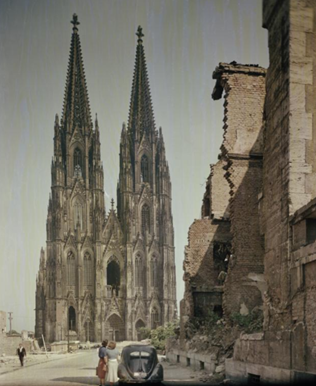
However, it would be years before the streets could be used again after the war. The people of Cologne at the time gradually removed the rubble in painstaking work until the actual reconstruction could begin. However, the unbelievable amounts of rubble had to go somewhere first. A pragmatic Cologne solution was found: the rubble was piled up in huge heaps around the city center and planted. By 1960, eleven piles of rubble had been created. These include the hill at Aachener Weiher and the Herkulesberg, also known as “Mont Klamott” – from which, incidentally, you have the best view of the cathedral today.
Romans and bunkers
Right next to the cathedral stands one of the largest structures from the war, albeit almost invisible: the cathedral bunker. When it was built in 1941, the huge Roman Dyonisos mosaic was found here. It can still be viewed at the site where it was found. In the Roman-Germanic Museum, which was simply placed on top of the bunker in the 1970s, thus hiding it.
Other former air raid shelters are also barely recognizable as such today. For example, the high-rise bunker on Breslauer Platz, which could easily pass for a modern office building with its glass cladding. Others disguise themselves with their towers as “church bunkers”. One of this type can be found in Mülheim on Berliner Straße and now houses a cultural center. The Ehrenfeld bunker in Körnerstraße is also used for cultural purposes, mainly for exhibitions and art markets.
TimeRide Cologne 1945
It was a long way before these relics of the war could be put to such use. This summer, TimeRide is telling the story of how this began in Cologne with a new VR program that jumps back to the immediate post-war period, when hundreds of thousands of Cologne residents really did what Willi Ostermann once sang about: “zo Foß noh Kölle gon.”